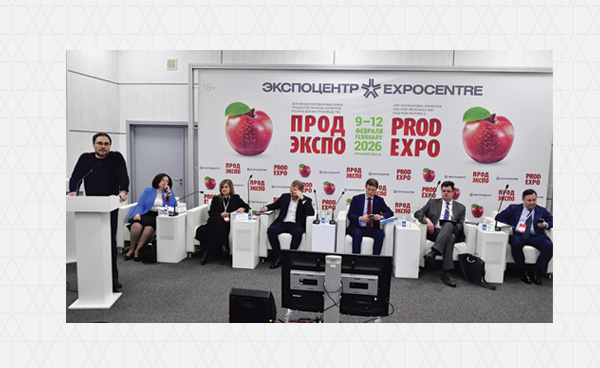

Prodexpo 2026 hosted Roskachestvo plenary session
The Russian Quality System (Roskachestvo) and EXPOCENTRE organised the Plenary Session on the Food Market: Omnichannel Retail, Regulatory Changes, New Consumer Trends. Challenges and Solutions within a conference programme of Prodexpo 2026. Mikhail Burmistrov, CEO at Infoline-Analytics, moderated the event. He opened the discussion noting that 2026 presented unprecedented challenges to the industry, including the beginning of a trend towards slowing real incomes of the population and the transformation of the labor market.
Elena Dybova, Vice President at the Russian Chamber of Commerce and Industry, stressed that in the context of changing technological patterns, businesses need to learn how to unite. According to her, modern companies face black swans when a brand's long-standing reputation can be destroyed by a single viral comment on social media. She also drew attention to the imbalance in regulation. “We see excessive demands on some players and insufficient demands on others, especially in the field of online trading. It is important to set up rules so that all links in the chain have the opportunity to earn money, and quality remains a priority for the state,” said Elena Dybova.
Maxim Borovoy, Russian Deputy Minister of Agriculture, said that the industry faces an ambitious goal of increasing production by 25% by 2030. However, he noted that against the background of the strengthening of the ruble, the domestic market is becoming more attractive for imports, which creates pressure on our manufacturers. “To ensure food security, we need to increase internal efficiency and reduce production costs by working with genetics and breeding. At the same time, the physical accessibility of products remains a key factor: we cannot allow a situation in which settlements will remain without classic retail,” said Mr. Borovoy.
Nikita Kuznetsov, Director of the Department for the Development of Domestic Trade at the Russian Ministry of Industry and Trade, highlighted the fundamental transformation of consumer behavior. According to his observations, people are switching to reasonable consumption: they buy less often and less, but choose better and more expensive goods. He named ready-made food in retail chains as one of the fastest growing categories. Mr. Kuznetsov also focused on the role of traditional stores saying that “physical accessibility is the basis of the doctrine of food security, and it is provided by offline retail; delivery cannot fully fulfill this function, especially in difficult situations.”
Maxim Protasov, Head at Roskachestvo, presented a detailed analysis of the consumer trends in 2026, noting that time has become the highest value for customers, and speed is the new norm. According to the presentation, 73% of customers today use multiple sales channels, and 83% study the characteristics of products online before visiting a store. Mr. Protasov emphasized the importance of the quality factor: trust in the state Quality Mark has grown to 85%, and 84% of consumers trust Roskachestvo's research.
In conclusion, Maxim Protasov spoke about new initiatives. “We are actively implementing standards for new niches. Over the past year, a roadmap for the development of the Halal market has been signed. National standards for ready meals and standards for online retailers are now being created. Our goal is to make the Russian market transparent and efficient, and to ensure consistently high-quality products," said Mr. Protasov.
The plenary session was also attended by Timofey Nizhegorodtsev, Deputy Head at the Federal Antimonopoly Service of Russia, Naira Karapetyan, Director at the EEC Department of Agroindustrial Policy, Ilya Ilyushin, Head at Agroexport, and heads of leading industry associations.
Press Service, EXPOCENTRE AO